
Valeriia Hutskalova is a humorous "toolmaker" in Chemistry
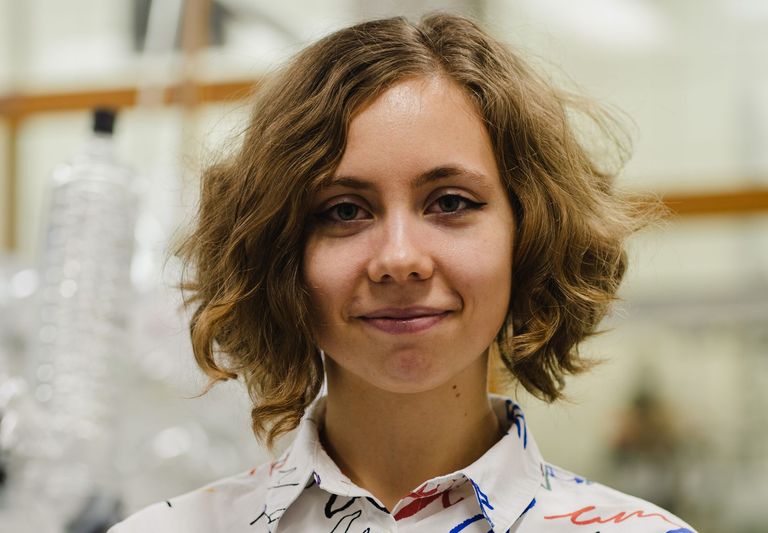
Prix Schläfli 2026 for Chemistry: She really wanted to be a pianist, but she found enjoyment in chemistry. And Valeriia Hutskalova has now been awarded the Prix Schläfli. In her thesis at the University of Basel, she showed that even particularly stable molecule rings can be intentionally “cut” and put together again.
Astrid Tomczak-Plewka
There was a moment in Valeriia Hutskalova's life when the teenager took part in the Science Olympics for Chemistry with her school. "That was very popular at home in Ukraine," she explains. "And it was so much fun." Before this, Valeriia was in fact fixated on something completely different. She wanted to be a pianist, was studying at the Conservatory and practised diligently. This was hardly surprising as her mother, who she emulated, set her an example. And yet come the said day, she knew: "It was Chemistry and nothing else. That was the eureka moment in my life." For the rest of her time at grammar school, the student concentrated on chemistry, subsequently studied in Kyiv and then moved to Basel in 2019 for her Masters, where she later wrote her thesis. It seems it was the right change of direction because this young woman has been awarded this year's Prix Schläfli for Chemistry. And anyone who talks to her gets the impression that even years later she has not lost her enjoyment of the subject. "As a child I sought explanations for literally everything, including the question of why we function as human beings, which molecules are in our bodies, how medicines are made and how they work," she says. "I still think these are fascinating questions, even if I am concerned with more complex issues nowadays."
What no one thought possible
Valeriia uses an image to help make this complexity comprehensible. "We have a kind of toolbox in organic synthesis," she explains. "Some tools are like scissors and cut molecules, others glue them together." Valeriia Hutskalova expanded on this toolbox in her thesis. The PhD student developed a method for opening what are known as aromatic rings – particularly stable structures which have long been considered difficult to change in any way. So the surprise was all the greater when she succeeded: "Many people didn't believe that these rings could ever be cut," she says. "That was one of these crazy projects during which you have no idea whether it will work," she says. The fact that it did, after a long process, "was the cherry on the top". This could give rise to completely new possibilities, such as more targeted production of active ingredients. Aromatic compounds are found in most medicines. If you are able to split them open and combine them again, you can open up new opportunities for chemistry. At the same time, her work provides a basis for future methods for producing complex molecules more easily and efficiently.
Valeriia Hutskalova gained industrial experience even during her studies, and although she was able to do many things that interested her, there was still something missing. "In industry you are more bound by the demands of the sector," she says. In the academic world, on the other hand, she has the freedom "to choose the challenge and issue that you want to address". Including "crazy ideas" where it is unclear whether they will work at all and whose use only becomes apparent later. "It's a great success if it works, not just for oneself, but also for others who are able to build on it."
Her work at Oxford, where she is currently a post-doctoral researcher and enthusiastic lecturer, is also characterised by this integrated, forward-looking mindset. "I try to pass on as much as possible to them," she says. And she dreams the dream of many junior researchers – to one day put together her own research group, preferably in Germany or Switzerland. "I had a good experience there and would love to go back."
Humour is her superpower
The word "return" naturally makes thoughts turn to her homeland. Her family is in Ukraine, and her brother is serving in the war as a surgeon. "Of course it worries me greatly and my thoughts are often with my family in Ukraine," she says. "But I think that in such situations you should concentrate on what you do best. For me, this is researching and teaching." The same applies to her colleagues in Ukraine. "They are continuing their work despite the war and under very difficult and dangerous conditions, which inspires me greatly." She admires them for it and tries not to let the war affect her. This is why she also pursues her hobbies. She couldn't take her piano with her to England. Instead of playing music, she goes to the gym and takes part in all the group classes there. And she draws. "When I'm drawing, I forget everything and look to the next day with a positive attitude." She also displays this positive attitude in the conversation with her. She smiles a lot and comes across as relaxed and happy. She ascribes this to where she comes from. "In Ukraine, Odessa is regarded as the capital of humour," she explains. "This has rubbed off on me." She sometimes tells her students a joke to get their attention. And when her research doesn't always go the way she hopes, she also seeks consolation in humour. "It's practically my superpower. I prefer to laugh about a failed experiment rather than get annoyed."
